
Key takeaways
- The best fluid for a smooth tantalum finish is a fully fluorinated, sulfur-free synthetic machining oil. In Lawrence Livermore National Laboratory (LLNL) turning trials, InfinX MWF M+ (formerly Halocarbon MWF-32) finished pure tantalum at 0.14–0.21 µm Ra, versus 0.45–0.70 µm Ra for conventional oil – 3× to 5× smoother.
- The single lowest measured value was 0.138 µm Ra (LLNL profilometer data).
- Against several other high-end vendor oils in the same trials, InfinX MWF M+ delivered roughly 2× better roughing finish and up to 5× better final finish.
- A near-polished, as-machined finish reduces or eliminates hand polishing, protecting sharp edges, engraved detail and tight tolerances.
A flawless tantalum surface finish is achieved by cutting the metal with a fully fluorinated, sulfur-free synthetic machining fluid that reduces tool–workpiece friction and prevents built-up edge. Pure tantalum is notoriously “gummy” – it tears and smears instead of shearing cleanly, leaving a matte, gouged surface that historically demanded hours of hand polishing. Using InfinX MWF M+, precision manufacturers have machined pure tantalum to 0.14–0.21 µm Ra in Lawrence Livermore National Laboratory trials – 3× to 5× smoother than the same cuts made with conventional oil, and smooth enough to come off the lathe looking nearly polished. This article explains why tantalum resists a clean finish and how fluorinated fluid technology solves the root cause.
Key definition: Tantalum surface finish is the measured smoothness of a tantalum part after machining, usually expressed as Ra – the arithmetic average roughness in micrometers. Lower Ra means a smoother surface; finishes at or below about 0.2 µm Ra are considered inspection-ready and near-polished straight off the machine.
Why is tantalum so hard to finish smoothly?
Tantalum is difficult to finish because its physical properties make it deform rather than shear. With a melting point above 3,000 °C, high ductility, strong strain-hardening and low thermal conductivity, tantalum forms thick, continuous chips under large cutting forces while heat concentrates at the cutting edge. That hot, sticky condition produces built-up edge – deposits of tantalum weld onto the tool, then tear and smear across the workpiece, leaving gouges and a matte, irregular texture. The same corrosion resistance and dense, grey-blue lustre that make tantalum attractive for high-end components, luxury goods and housings are what make it punishing to finish.
Historically, machinists countered this with heavily chlorinated cutting oils, whose extreme-pressure additives stop metal adhering to the tool. Those oils work, but carry real drawbacks: strong odors, health and disposal concerns, and compatibility issues with modern shops. The result was a persistent trade-off between finish quality and a clean, safe process.
Why built-up edge ruins the finish: when tantalum welds to the cutting edge, the tool stops cutting cleanly and starts ploughing. Each time the built-up edge breaks off, it drags material across the fresh surface – the direct cause of tantalum’s characteristic tearing and smearing.
What cutting fluid gives the best tantalum surface finish?
The best surface finish on tantalum comes from a fully fluorinated, sulfur-free synthetic machining oil. InfinX MWF M+ is a medium-viscosity, high-purity fluorinated fluid engineered for difficult metals such as tantalum and niobium. Unlike conventional mineral or vegetable oils, it delivers high lubricity and thermal stability without sulfur, so the cutting tool stays cooler and cleaner.
Mechanically, the fluid works on the root cause. It sharply lowers friction at the tool–workpiece interface, mitigating the rubbing and adhesion that mar a tantalum surface. Chips slide off cleanly instead of sticking and ploughing, and the fluid promotes well-formed spiral chips rather than long, jagged ribbons. Better chip control means fewer stray chips scoring the part and far less built-up edge tearing the material – which is what produces the smoother finish.
How much smoother is the finish? (Lawrence Livermore National Laboratory data)
In collaboration with Lawrence Livermore National Laboratory, Halocarbon ran turning trials on pure tantalum comparing MWF-32 – the formulation now sold as InfinX MWF M+ – against standard cutting oils. The finish improvement was measured, not estimated:
Table 1 – Surface finish on pure tantalum: InfinX MWF M+ vs. conventional oil
| Cutting fluid | Achieved roughness (Ra) on tantalum¹ | Improvement vs. conventional |
|---|---|---|
| InfinX MWF M+ (tested as Halocarbon MWF-32) | ~0.14–0.21 µm (ultra-smooth; 0.138 µm lowest recorded) | 3× – 5× smoother |
| Conventional oil (standard) | ~0.45–0.70 µm (rough finish) | – baseline – |
| Other high-end vendor oils | ~2× rougher in roughing; up to 5× rougher in finishing | InfinX MWF M+ 2× (roughing) to 5× (finish) smoother |
¹ Single-point turning, finish pass on pure tantalum. Lower Ra = smoother surface. Source: Lawrence Livermore National Laboratory profilometer data, Halocarbon machining trials.
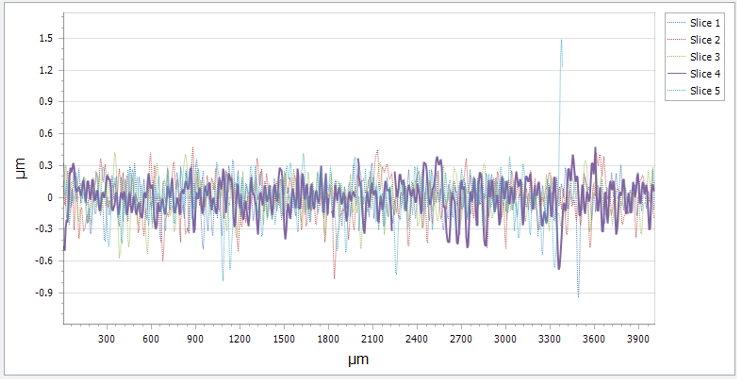
Lawrence Livermore National Laboratory: surface-finish profilometer data after turning tantalum with Halocarbon MWF-32 – 0.138 µm Ra.
Quotable result: “Tantalum turned with InfinX MWF M+ (Halocarbon MWF-32) measured 0.14–0.21 µm Ra – 3× to 5× smoother than the same cuts made with conventional oil, according to Lawrence Livermore National Laboratory profilometer data.”
A 3× to 5× improvement is roughly a 70–80% reduction in measured Ra – a step change, not an incremental gain, and a level of smoothness that tooling or speed-and-feed tweaks alone cannot reach. Samples cut with InfinX MWF M+ approach a polish-like finish straight off the machine, with minimal tool marks or lay pattern. Published research on tantalum machining supports the mechanism: improved cutting-fluid performance correlates with reduced surface roughness on this metal.
What does a near-polished, as-machined finish mean for your shop?
For precision manufacturers, an inspection-ready finish off the machine translates directly into quality and efficiency gains:
- Visually flawless finishes – tantalum cases and parts come off the CNC with an almost mirror-like sheen that meets strict aesthetic standards.
- Less rework and polishing – one-pass machining with InfinX MWF M+ often replaces multiple downstream finishing operations, saving hours of hand labor.
- Protected detail and tolerances – because little post-machining buffing is needed, engraved logos, sharp case lines and tight tolerances stay intact.
- Consistent results – the fluid is chemically inert and does not break down under heat, so performance holds from the first part to the hundredth.
- Better part integrity – a smoother cut surface means fewer micro-tears and stress risers, which matters for components expected to last for generations.
What are the limitations?
The reported figures come from controlled single-point turning trials on pure tantalum; results on tantalum alloys, other geometries or different operations (milling, drilling, Swiss work) will vary with tooling and parameters. A fluorinated fluid also doesn’t remove the need for sound machining practice – sharp, high-positive-rake tooling still matters for a clean shear. The fluid’s role is to eliminate the friction, heat and adhesion that otherwise cap the achievable finish.
Conclusion: surface finish without compromise
Tantalum has a reputation for turning dull or uneven under normal machining – but that reputation is changing. By addressing the root causes of tantalum’s finish problems – friction, heat and chip adhesion – InfinX MWF M+ delivers measured 0.14–0.21 µm Ra finishes without the odor, health and disposal issues of old chlorinated oils. Manufacturers no longer have to avoid tantalum or settle for sub-par finishes; they can treat it as a viable, even preferred, production material.
Ready for inspection-ready tantalum finishes straight off the machine? Request a sample of InfinX MWF M+ or contact our technical team for a consultation.
Frequently asked questions
What is the best cutting fluid for machining tantalum?
The best cutting fluid for tantalum is a fully fluorinated, sulfur-free synthetic machining oil such as InfinX MWF M+. It reduces tool–workpiece friction and prevents built-up edge, which are the main causes of tantalum’s tearing and rough finish.
How smooth can a tantalum surface finish be?
In Lawrence Livermore National Laboratory turning trials, pure tantalum machined with InfinX MWF M+ (Halocarbon MWF-32) reached 0.14–0.21 µm Ra, with a lowest recorded value of 0.138 µm, compared with 0.45–0.70 µm Ra using conventional oil – a 3× to 5× smoother finish that is near-polished straight off the machine.
Why is tantalum so difficult to machine to a smooth finish?
Tantalum is highly ductile and strain-hardens, so it deforms into thick, continuous chips instead of shearing cleanly. Its low thermal conductivity concentrates heat at the cutting edge, causing built-up edge that tears and smears the surface, leaving a matte, gouged texture.
Does machining tantalum with fluorinated fluid remove the need for hand polishing?
Often, yes. Because InfinX MWF M+ produces a near-polished finish off the machine, it reduces or eliminates downstream hand polishing and lapping. This preserves sharp edges and fine detail while saving hours of finishing labor, though final requirements depend on the part’s specification.
Is fluorinated metalworking fluid better than chlorinated cutting oil for tantalum?
Fluorinated fluid delivers comparable or better anti-adhesion performance without the odor, health and disposal concerns of high-chlorine oils. It is chemically inert, sulfur-free and stable under heat, so it protects the finish while fitting cleanly into modern shop environments.