
Key takeaways
- Tantalum is machinable with confidence when you cut it with a fluorinated, sulfur-free synthetic fluid that halves friction and stops built-up edge.
- In laboratory testing, InfinX MWF M+ (formerly Halocarbon MWF-32) cut friction roughly in half versus conventional oil and extended tool life 50% in roughing cuts – up to 5× in some cases – on refractory metals such as tantalum and tungsten.
- At Lawrence Livermore National Laboratory, engineers reported “chip control was a tight spiral and very easy to manage” using standard Kennametal inserts.
- A standardized milling test showed a 24% surface-finish improvement (1.457 µm vs 1.910 µm Ra); a semi-finishing trial reached 4 passes per insert edge where 1–2 is normal – roughly doubling productivity.
- InfinX MWF M+ is a drop-in replacement for existing CNC lathes, mills and Swiss machines, applied by flood, MQL or manual brushing.
Tantalum machining is best done with a fluorinated, sulfur-free synthetic metalworking fluid that reduces friction, prevents built-up edge and controls tantalum’s thick chips. Tantalum – prized for corrosion resistance, high-temperature strength and its distinctive dense feel – has long earned nicknames like “the machinist’s nightmare” because it produces thick, unruly chips, wears tools rapidly and yields poor finishes. Using InfinX MWF M+, precision manufacturers now machine tantalum with better tool life, cleaner chips and superior part quality: laboratory tests show friction cut in half, tool life extended 50% up to 5×, and, at Lawrence Livermore National Laboratory, chip control described as “a tight spiral and very easy to manage.” This article explains why tantalum is so difficult and how fluorinated fluid technology makes it routine.
Key definition: Tantalum machining is the process of turning, milling or drilling tantalum – a highly ductile refractory metal – into finished parts. It is difficult because tantalum strain-hardens and has low thermal conductivity, so it forms thick chips and builds up on the cutting tool unless friction and heat are controlled by a specialized fluid and sharp tooling.
Why is tantalum so difficult to machine?
Tantalum is difficult to machine because of its physical and mechanical quirks. It is extremely ductile and strain-hardens readily, so when a tool engages it, the metal stretches and deforms instead of shearing into neat slivers. That produces very thick chips and high cutting forces – observed chip-thickness ratios of about 30–50 for tantalum, versus 10–20 for easier metals like aluminum.
Those thick chips carry substantial heat, but tantalum’s low thermal conductivity keeps the heat near the cutting zone. The hot, plasticized metal then sticks to the tool as built-up edge, which intermittently breaks off, gouges the workpiece and worsens the finish. The overall effect is a sinuous, unsteady material flow that makes precision cutting nearly impossible with standard methods – which is why its machinability is frequently described as “chewy”.
How machinists have historically coped:
- Sharp, high-rake tooling – carbide inserts with high positive rake and very sharp edges reduce cutting forces and help slice the “gummy” metal more cleanly; toolmakers sometimes develop special grind geometries for tantalum.
- Chlorinated cutting oils – heavily chlorinated straight oils create an extreme-pressure film that minimizes built-up edge and scoring, but bring smoke, odor and disposal concerns, and can attack machine components.
Even with these measures, tantalum stays slow and taxing: rapid tool wear (often only a handful of parts per tool), and long, spring-like chips that tangle around the tool or scratch a nearly finished part.
What makes InfinX MWF M+ work on tantalum?
InfinX MWF M+ is a synthetic fluorinated metalworking fluid formulated for refractory metals like tantalum. It contains no sulfur; instead it uses the inherent lubricity of fluorinated compounds to cool and lubricate the cutting interface. It attacks tantalum’s problems on four fronts:
- Reduced friction and heat – in twist-compression laboratory tests, Halocarbon fluids cut friction roughly in half versus conventional oils. Lower friction means lower cutting forces and less heat, so tantalum shears cleanly at lower force and tool edges stay intact longer instead of softening or micro-cracking.
- Prevention of built-up edge – the fluid’s molecular structure maintains a persistent lubricating film that prevents metal-to-metal welding. Unlike water-based coolants that can flash to steam on hot tantalum, the oil stays present and effective, and operators report the tool comes out nearly clean even after several passes.
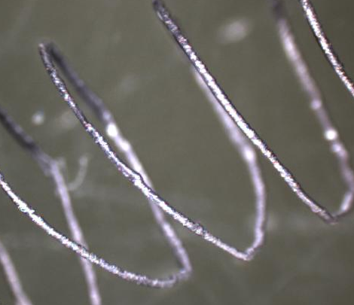
- Cleaner chip formation – the fluid’s lubricity and cooling let tantalum fracture into tight curls or manageable segments instead of long coils, as also seen on tungsten, protecting the part and enabling higher automated machining rates.
- Extended tool life – cooler, cleaner cutting keeps carbide inserts sharp far longer (see the data below).
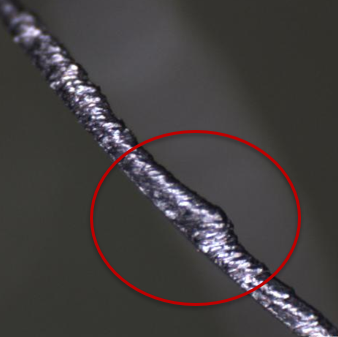
Lawrence Livermore National Laboratory: minimal built-up edge when finish turning tantalum with Halocarbon MWF-32.
Why this matters: built-up edge is the common cause of tantalum’s three biggest machining problems – poor finish, rapid tool wear and tangled chips. Eliminate the welding at the tool edge, and all three improve at once.
How much do tool life and chip control improve? (measured results)
Halocarbon’s claims are backed by data from independent testing and a trial at the Lawrence Livermore National Laboratory Special Materials Machining Facility.
Table 1 – Tantalum machining: InfinX MWF M+ vs. conventional fluid
| Metric | Conventional fluid | InfinX MWF M+ (tested as MWF-32) | Source / test |
|---|---|---|---|
| Friction at cutting interface | Baseline | ~50% lower | Twist-compression laboratory tests |
| Tool life (roughing, refractory metals) | Baseline | +50%, up to 5× in some cases | Independent tests, tantalum & tungsten |
| Surface finish (standardized milling) | 1.910 µm Ra | 1.457 µm Ra (24% better) | Standardized milling test |
| Passes per insert edge (semi-finishing) | 1–2 (normal) | 4 passes (≈ doubled productivity) | Semi-finishing trial |
| Chip control | Long, tangling coils | “Tight spiral, very easy to manage” (standard Kennametal inserts) | LLNL Special Materials Machining Facility |
| Built-up edge | Significant | Minimal; tool nearly clean after several passes | LLNL turning trial |
Sources: Halocarbon laboratory and independent test program; Lawrence Livermore National Laboratory Special Materials Machining Facility turning trial.
Quotable result: “With Halocarbon fluid, chip control was a tight spiral and very easy to manage,” Manufacturing Supervisor at the Lawrence Livermore National Laboratory Special Materials Machining Facility reported – even using standard Kennametal inserts.
Quotable result: “Independent tests on refractory alloys such as tantalum and tungsten showed Halocarbon MWF extending tool life 50% in roughing cuts, and up to 5× compared with a leading conventional fluid.”
Is InfinX MWF M+ a drop-in replacement?
Yes. InfinX MWF M+ is a drop-in replacement fluid for existing CNC lathes, mills and Swiss machines – no process overhaul required. It’s available in multiple viscosity grades and can be applied by flooding, minimum-quantity lubrication (MQL) or manual brushing. It’s compatible with common machine materials and won’t corrode copper or reactive metals.
Maintenance is simpler, too: because it’s a pure synthetic with no water or biological ingredients, it won’t foster bacterial growth or emit foul odors in sumps – one reason shop staff often note that, unlike old chlorinated oils, it “doesn’t stink.”
Which industries benefit most?
Tantalum’s combination of corrosion resistance, biocompatibility and high-temperature strength makes it valuable across sectors that previously found it too costly to machine:
- Medical devices – tantalum surgical implants and instruments can be machined to the surface integrity required for human-contact devices.
- Aerospace – space and turbine components where tight tolerances meet demanding materials.
- Luxury and specialty goods – tantalum housings, cases and watch components with crisp geometry straight off the machine.
- Other refractory-metal work – the same benefits extend to tungsten and Inconel®, giving shops a single fluid strategy for the hardest alloys.
What are the limitations?
The figures cited come from specific laboratory and trial conditions (identified operations, inserts and parameters); results in production will vary with tooling, geometry and setup. The 24% Ra figure is from a standardized milling test and the 3–5× finish improvement from turning – they describe different operations. A high-performance fluid also complements, rather than replaces, sound machining practice: sharp, high-positive-rake carbide tooling remains important for a clean shear on tantalum.
Conclusion: redefining what’s possible with tantalum
Tantalum no longer needs to be the metal you dread on the job schedule. By turning extreme machining problems – thick chips, rapid wear, poor finish – into routine operations, InfinX MWF M+ lets precision manufacturers machine tantalum more efficiently, more cleanly and with greater consistency. Shops adopting it report cleaner operations, improved cycle times and higher first-pass yield on tantalum, tungsten and Inconel® – a real competitive edge on everything from luxury timepieces to critical aerospace parts.
If tantalum or other refractory metals are on your horizon, request a sample of InfinX MWF M+ or reach out to our technical team to discuss your specific machining challenges.
Frequently asked questions
Why is tantalum so hard to machine?
Tantalum is extremely ductile and strain-hardens, so it deforms into thick chips (chip-thickness ratios around 30–50, versus 10–20 for aluminum) instead of shearing cleanly. Its low thermal conductivity traps heat at the cutting edge, causing built-up edge that wears tools rapidly and ruins the finish.
What is the best metalworking fluid for tantalum?
A fluorinated, sulfur-free synthetic fluid such as InfinX MWF M+ is engineered for tantalum and other refractory metals. In laboratory tests it cut friction roughly in half and extended tool life by 50% up to 5×, while producing tight, manageable chips.
How much longer does tooling last when machining tantalum with InfinX MWF M+?
Independent tests on refractory alloys such as tantalum and tungsten showed Halocarbon MWF extending tool life 50% in roughing cuts, and up to 5× in some cases, versus a leading conventional fluid. In one semi-finishing trial, machinists achieved 4 passes per insert edge where 1–2 is normal.
Is InfinX MWF M+ a drop-in replacement for my current cutting oil?
Yes. InfinX MWF M+ works in existing CNC lathes, mills and Swiss machines with no process changes. It comes in multiple viscosity grades, applies by flood, MQL or brushing, won’t corrode copper or reactive metals, and – being water-free and sulfur-free – resists bacterial growth and odor.
Can tantalum be machined for medical implants?
Yes. Tantalum is biocompatible and corrosion-resistant, and with a fluorinated fluid like InfinX MWF M+ it can be machined to the surface integrity and precision required for surgical implants and instruments, reducing built-up edge and improving finish on human-contact devices.
Does InfinX MWF M+ work on other hard metals besides tantalum?
Yes. The same friction, tool-life and chip-control benefits extend to other refractory and difficult alloys, including tungsten and Inconel, letting shops standardize on one fluid strategy for the toughest materials.